
Salary Sacrifice Explained: Why It's Not Really a Sacrifice
"Sacrifice" sounds like you're giving something up. You're not. You're making a deliberate choice about how your income works for you.
Salary sacrifice is one of the few ways to keep more of your earnings by directing them somewhere useful before tax is calculated. The government designed it this way to encourage pension saving, electric car adoption, and cycling to work. You're not gaming the system. You're using it exactly as intended.
Here's how it works, what you can use it for, and whether it's worth doing at your salary.
What actually happens to your money
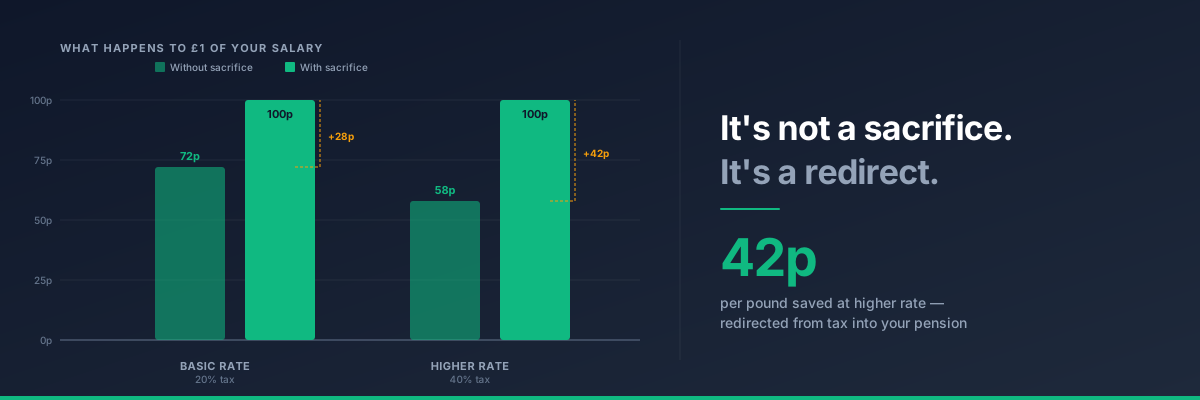
Say you earn £45,000. For every pound above your tax-free allowance, 20p goes to income tax and 8p to National Insurance. You keep 72p.
With salary sacrifice, that £1 goes straight into your pension (or toward an electric car, or a bike) before tax is calculated. You "lost" 72p of take-home, but you gained £1 of pension. That 28p difference stayed in your pocket instead of going through the tax system. It's not a loophole. It's a deliberate incentive built into the tax code.
HMRC publishes guidance on salary sacrifice arrangements and employers set up schemes specifically for this purpose. The tax relief exists because the government wants people saving into pensions and switching to electric vehicles.
See what you'd save at your salary: Salary Sacrifice Calculator
Where should the money go?
Three main options. The right one depends on what you actually need.
Pension: the default answer
If you're not sure, pension is almost always the right choice.
The tax saving is the same whether you sacrifice into a pension, an EV, or a bike. But with a pension, the money compounds. That means you earn returns on your returns, year after year. Einstein allegedly called it the eighth wonder of the world. Whether he actually said that or not, the maths backs it up.
The tax saving alone isn't what makes this compelling. It's running the numbers over 20 years. The immediate saving looks modest: 40p on every pound sacrificed at higher rate. But that 40p is now sitting in a pension, invested and growing. At 5% growth over 20 years, every £1 of redirected tax becomes roughly £2.65. That's growth on growth, on money you'd never have been able to invest without sacrifice.
Say you're a higher-rate taxpayer sacrificing £300/month. It costs you about £174 in take-home pay. The other £126, the tax and NI you redirected, goes into your pension and compounds alongside everything else. Over 20 years at 5% growth, that £126/month alone becomes roughly £52,000. You didn't earn it. You didn't take extra risk. You just made a choice about where your income goes before tax, and let compound growth do the work.
Electric car: the one everyone's talking about
Pure EVs attract a Benefit-in-Kind rate of just 4% for 2026/27, against up to 37% for a petrol or diesel car, which is why EV sacrifice can work out 20-35% cheaper than a personal lease, depending on your tax band. The catch is the early-exit terms if you leave your job mid-lease, which vary widely by scheme provider.
Full deep-dive with worked numbers for basic, higher and additional rate taxpayers, plus a like-for-like comparison against personal lease and cash purchase: Is EV Salary Sacrifice Worth It in 2026/27?
Cycle-to-work: the quick win
Save 28-42% on a bike and accessories depending on your tax band. The maths is the same as pension and EV sacrifice: you pay from gross salary instead of net.
A £1,500 e-bike might cost you £870-1,080 through the scheme. Payments come off your salary over 12-18 months. The percentage saving is comparable to pension and EV sacrifice because the underlying tax mechanics are identical. The absolute numbers are smaller simply because bikes cost less than cars or annual pension contributions. If you're going to spend £1,500 on a bike, use salary sacrifice and get the exact same bike with a £420-630 discount.
Show me the numbers
The tax saving depends on your salary and what you sacrifice. Here are three scenarios.
Near £100,000: not optional
If a raise or bonus pushes you above £100,000, you start losing your personal allowance at a rate of £1 for every £2 earned over the threshold. This creates an effective 62% marginal tax rate between £100,000 and £125,140.
We've covered this in detail: The £100K cliff edge and £100K Tax Trap calculator.
If you're anywhere near £100,000, run the numbers before your next pay review. The difference between sacrificing and not sacrificing at this threshold can be worth over £10,000 per year when you factor in childcare.
The stuff people worry about
Will it affect my mortgage application?
It can. Some lenders look at your post-sacrifice salary as your income. Others look at your gross before sacrifice. Most major lenders understand salary sacrifice and will use your full contractual salary, but ask your broker or lender directly before assuming. This is worth a conversation, not worth avoiding sacrifice over.
Does it reduce my state pension?
Only if sacrifice takes your earnings below £6,396/year (the lower earnings limit for NI qualifying years). If you're earning £30,000+ and sacrificing a few hundred a month, you're nowhere near this. Not a concern for the vast majority of people.
What happens if I leave my job?
For pension sacrifice, everything you've contributed stays in your pension until retirement. You don't lose anything. You'd just need to set up salary sacrifice again with your new employer if they offer it.
EV leases are different. You've entered a lease agreement and early termination terms apply. Some schemes include protection if you leave (Octopus EV, for example, offers this). Others don't. Check before you sign, because unwinding a 3-year car lease mid-contract can be expensive.
Can anyone do this?
Your employer has to offer it. You can't set up salary sacrifice on your own. It's a formal agreement to reduce your contractual pay in exchange for a benefit. Most medium and large employers offer pension sacrifice. EV and cycle schemes are growing but less universal. If your employer doesn't offer it, you can ask, but they're not obliged to set one up.
Does it reduce my student loan repayments?
Yes. Salary sacrifice reduces your gross pay, which reduces your student loan repayment threshold income. On a Plan 2 loan at £55,000 with a £5,000 sacrifice, you'd save roughly £432/year in loan repayments on top of the tax and NI savings. This one catches people by surprise — in a good way.
How to actually do it
If your employer offers pension salary sacrifice (most do), it's usually a form on your HR portal or a conversation with payroll. It takes about five minutes. You choose how much to sacrifice, it starts from your next pay cycle, and you can usually change the amount once or twice a year.
For EV and cycle-to-work schemes, your employer needs to be registered with a scheme provider. Ask your HR team whether they offer one. If they don't, forward them this article. The employer saves on NI too, so it's in their interest to set it up.
Pension sacrifice
EV salary sacrifice
Cycle-to-work
The hardest part of salary sacrifice is getting past the name. Once you see the numbers, the decision is obvious.
Run your own numbers
Your situation will be different. Salary, tax band, employer match, student loans — all shift the calculation.
If you're near the £100,000 threshold, also check the £100K Tax Trap calculator. The savings at that level are in a different league.
References
- Salary sacrifice and the effects on PAYE — GOV.UK (accessed March 2026)
- Income Tax rates and Personal Allowances — GOV.UK (accessed March 2026)
- National Insurance rates and categories — GOV.UK (accessed March 2026)
- Workplace pensions — employer contributions — GOV.UK (accessed March 2026)