
Is EV Salary Sacrifice Worth It in 2026/27?
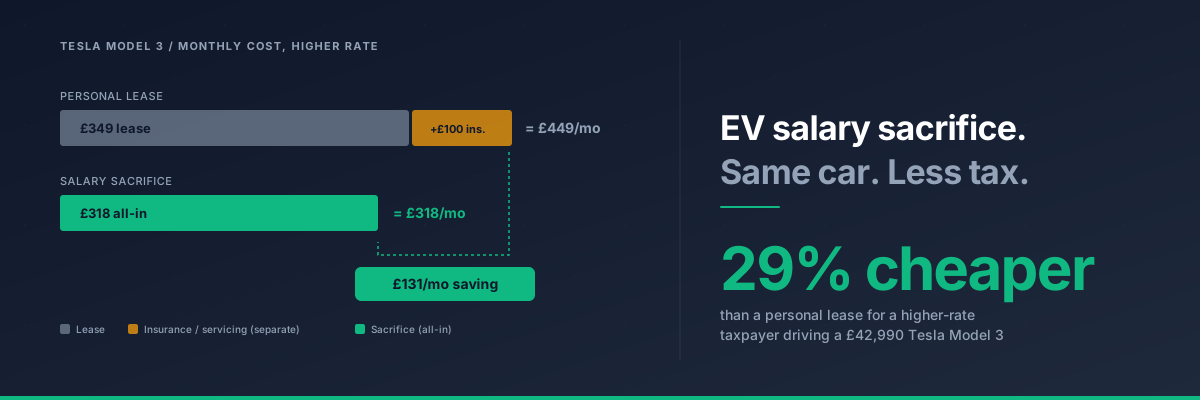
Salary sacrifice is the cheapest way for most UK employees to drive a new electric car. The reason is one number: the Benefit-in-Kind (BiK) rate on a pure electric vehicle is just 4% for 2026/27, compared with up to 37% for a petrol or diesel car. That single rule makes a £42,990 Tesla Model 3 cost a higher-rate driver around £318 a month from take-home pay, fully insured and serviced.
Below: the maths in plain English, three worked examples at different salaries, and an honest comparison of sacrifice against a personal lease and buying outright. Every figure comes from the SalaryTools salary sacrifice calculator using official 2026/27 HMRC rates, so you can reproduce any number yourself.
The quick answer
For most UK employees whose employer offers a scheme, yes, particularly if you're a higher-rate or additional-rate taxpayer. The savings versus a personal lease typically range from 20% (basic rate) to 35% (additional rate) of the monthly cost, and most schemes bundle insurance, servicing, breakdown cover, and tyres into that single figure.
It only stops making sense if you don't actually need a car, or if you're likely to leave your job inside the lease term and your scheme provider doesn't offer early-exit protection. Both are addressed below.
How the maths works
Three things happen at once when you take an electric car through a salary sacrifice scheme:
1. Your gross salary drops by the monthly lease cost. That reduces the income tax and National Insurance you pay. A higher-rate taxpayer sacrificing £450 a month avoids 40% income tax and 2% NI on that amount, saving roughly £189 a month before any other effects.
2. You pay BiK tax on the car. HMRC treats the company car as a taxable benefit. For a pure EV in 2026/27, the taxable benefit is 4% of the car's list price (P11D value). On a £42,990 Model 3, that's £1,720 of taxable benefit a year, costing a higher-rate driver £688 a year (£57/month) in extra tax.
3. Your employer saves on NI. Employers pay 15% Class 1 Secondary NICs on salary above the secondary threshold. A £450/month sacrifice saves your employer roughly £810 a year. Some employers pass part or all of this back as a fuel card, charger contribution, or extra pension match. Worth asking.
Worked examples by tax band
Three drivers, three salaries, three EVs. Every figure below comes from the same calculator engine that powers our salary sacrifice calculator and uses 2026/27 HMRC rates: 4% BiK for pure EVs, £12,570 personal allowance, £50,270 higher-rate threshold, £125,140 additional-rate threshold. Each example links to the calculator pre-filled with that exact scenario.
Basic rate: £40K salary, VW ID.3
Higher rate: £70K salary, Tesla Model 3
Additional rate: £140K salary, BMW i4
Sacrifice vs personal lease vs cash
Electric car salary sacrifice providers (sometimes called salary sacrifice car schemes) happily compare to a personal lease, but rarely to cash, and rarely fairly. Below: a like-for-like 36-month comparison for a Tesla Model 3 Long Range RWD (£44,990 list price) at higher rate. Sacrifice uses representative scheme rates from our calculator preset; PCH uses Tesla's own current promotional rate; cash assumes the buyer keeps the car for three years and ignores opportunity cost on the £45K capital.
| 36 months | Salary sacrifice | Personal lease (PCH) | Buy outright |
|---|---|---|---|
| Upfront cost | ~£0–1,500 | £4,187 | £44,990 |
| Headline monthly cost | £450 from gross | £349 from net | - |
| Effective monthly cost (40% taxpayer) | ~£318 from take-home | £349 from take-home | (depends on resale) |
| Includes insurance, servicing, breakdown | Usually yes | No (~£80-120/mo extra) | No (~£80-120/mo extra) |
| You own the car at the end | No | No | Yes (~50% of list value) |
For a higher-rate driver, the all-in monthly cost of sacrifice is typically £100-150/month lower than a personal lease once insurance and servicing are added back. The cash purchase looks expensive monthly but ends with a car worth ~£20-25K. Whether that beats sacrifice depends on how that car depreciates and what alternative use the £45K capital had.
What if you leave your job mid-lease?
This is the single biggest reason EV sacrifice goes wrong, and it's the question scheme providers bury deep in the FAQ. The honest answer: it depends entirely on your scheme provider, and the protections vary widely.
When you leave (resign, redundancy, long-term illness, parental leave), the salary sacrifice arrangement ends because there's no salary to sacrifice from. Three things can then happen:
Option A: early termination fee. The default for most schemes. You (or your employer) owe an exit fee, typically 3-6 months of lease payments plus a return condition charge. On a £450/month lease, that's £1,350-£2,700 plus damage. This comes from net pay, not gross.
Option B: early termination protection. Some providers (Octopus EV is the best-known) include redundancy/resignation protection in the base rate. The provider absorbs the early-exit cost. Read the policy carefully: protections often exclude voluntary resignation, or cap at one event per lease term.
Option C: transfer to a personal lease. A few providers let you continue payments from net pay at the same rate. This sounds attractive but you lose the tax saving (gross becomes net), so the effective monthly cost jumps roughly 40% for a higher-rate taxpayer. Rarely a good outcome.
BiK rates 2025/26 to 2029/30
The 4% pure-EV BiK rate is scheduled to rise each year through 2029/30. The legislation is already passed, so this is a planning fact, not a forecast.
| Tax year | Pure EV (0 g/km) | PHEV 130+ mi range | Petrol/diesel 100-109 g/km |
|---|---|---|---|
| 2025/26 | 3% | 3% | 26% |
| 2026/27 (current) | 4% | 4% | 27% |
| 2027/28 | 5% | 5% | 28% |
| 2028/29 | 7% | 7% | 29% |
| 2029/30 | 9% | 9% | 30% |
At 9% BiK in 2029/30, the higher-rate driver in the Model 3 example would pay ~£1,548/year in BiK tax instead of £688, knocking the effective discount from 29% down to roughly 18%. Sacrifice would still beat a personal lease, but the margin shrinks materially. If you're signing a 4-year lease in 2026, the back end of it sits in the 7-9% rate territory; budget accordingly.
PHEV vs pure EV
Plug-in hybrids in 2026/27 are taxed at the same 4% as pure EVs only if their electric range is 130+ miles, which is rare and usually expensive (BMW i5 PHEV, Mercedes E300e). Most PHEVs sit in the 70-129 mile range (7% BiK) or below (10-14% BiK). At 14% on a £45K PHEV, the BiK tax alone is £2,520/year for a higher-rate driver, wiping out most of the sacrifice saving.
Salary sacrifice on a pure electric vehicle almost always works. Sacrifice on a PHEV rarely does unless the PHEV has a long electric range. The salary sacrifice hub article covers the bike-and-pension cases too.
Sacrificing a bonus into an EV
If your employer pays a discretionary bonus, you can usually sacrifice all or part of it into an EV scheme, taking the lease commitment as a gross deduction before the bonus hits PAYE. This matters most at higher rate or near the £100K cliff edge.
Worked example: a £10,000 bonus for someone earning £95,000 would normally attract roughly 42% in tax and NI on the portion below £100K, then 62% on the portion above (the personal allowance taper kicks in at £100,001). Sacrificing that bonus into an EV lease keeps salary below the £100K cliff, preserving the full personal allowance and Tax-Free Childcare eligibility for parents. See how bonuses are taxed for the full bonus arithmetic.
A note for Scottish taxpayers
Scottish income tax bands are different: six bands instead of three, with marginal rates of 19%, 20%, 21%, 42%, 45% and 48%. The BiK rules and NI rules are UK-wide, but the income tax saving from sacrifice is calculated against the Scottish rates. For a Scottish higher-rate taxpayer (42% above £43,663), the per-pound saving is slightly higher than for the rest of the UK; for an additional-rate taxpayer (48% above £125,140), markedly so. Use the calculator with the Scottish toggle on to see your exact figures.
How to set it up
Electric car salary sacrifice runs through your employer. You can't set it up yourself. It's a contractual arrangement to reduce your gross pay in exchange for the lease.
Check if your employer is registered
Get the early-exit terms in writing
Run the numbers for your salary
Check the all-in cost vs personal lease
The maths almost always works for a pure EV at higher or additional rate. The question to spend more time on is the early-exit policy. That's where sacrifice goes from "obviously good" to "obvious problem" if you change jobs.
References
- Tax on company benefits: Tax on company cars - GOV.UK (accessed April 2026)
- Work out the appropriate percentage for company car benefits - GOV.UK (accessed April 2026)
- Salary sacrifice and the effects on PAYE - GOV.UK (accessed April 2026)
- Income Tax rates and Personal Allowances - GOV.UK (accessed April 2026)
- National Insurance rates and categories - GOV.UK (accessed April 2026)