
Redundancy pay and tax: what you keep, and how to keep more
Being made redundant is rotten. Even when you saw it coming, it lands hard, and the questions it throws up are rarely the tidy ones. How will I cover the bills next month? How long will it take to find something else? And the one most people never say out loud: was it me?
That last one has a straight answer, so let's start there. In law, redundancy means your employer needs fewer people doing a particular kind of work. It is a decision about a job, not a verdict on the person doing it, and your employer has to select people fairly. Plenty of very good people are made redundant, some of them more than once in a career.
The bills and the job hunt are harder, and a calculator site can't fix either. A few things are worth knowing early, though:
- If you have worked there 2 years or more, you are entitled to reasonable paid time off during your notice to look for work or arrange training.
- New Style Jobseeker's Allowance is based on your National Insurance record, and your savings, redundancy pay included, do not affect it.
- Acas and Citizens Advice both give free, confidential help if anything about the process feels off.
Where we can help is the money itself: how much you will get, how much of it goes in tax, and how to keep more of it, for the 2026/27 tax year. We have run every number below through our redundancy pay calculator, so you can check our working, or swap in your own figures and see where you land.
How much you will get
Start with the floor. Statutory redundancy pay is the minimum the law says your employer must pay you, whatever your contract says. You qualify if you are an employee (not a contractor or agency worker) and have worked for your employer for 2 years or more.
It is worked out from three things: your age, how many full years you have worked there, and your weekly pay. Each year of service earns you a number of weeks' pay, and the older you were during that year, the more it is worth:
| Your age during that year of service | Pay for that year | Most it can be worth per year |
|---|---|---|
| under 22 | half a week's pay | up to £375.50 |
| 22 to 40 | one week's pay | up to £751 |
| 41 or over | a week and a half's pay | up to £1,126.50 |
There are two limits. Weekly pay is capped at £751 for redundancies on or after 6 April 2026, so if you earn more than that, the calculation uses £751 anyway. And only your last 20 years count, working back from the day you leave. Put both together and the most statutory redundancy pay anyone can get is £22,530. In Northern Ireland the weekly cap is a little higher, at £783.
That is the floor, and many employers go well above it. Enhanced redundancy pay is anything your employer pays on top of the legal minimum. It might be a multiple of the statutory amount, your real weekly pay instead of the capped figure, more than 20 years counted, or some mix of the three. Your contract or staff handbook says what yours is, and if it doesn't, it is worth asking HR directly.
How it is taxed
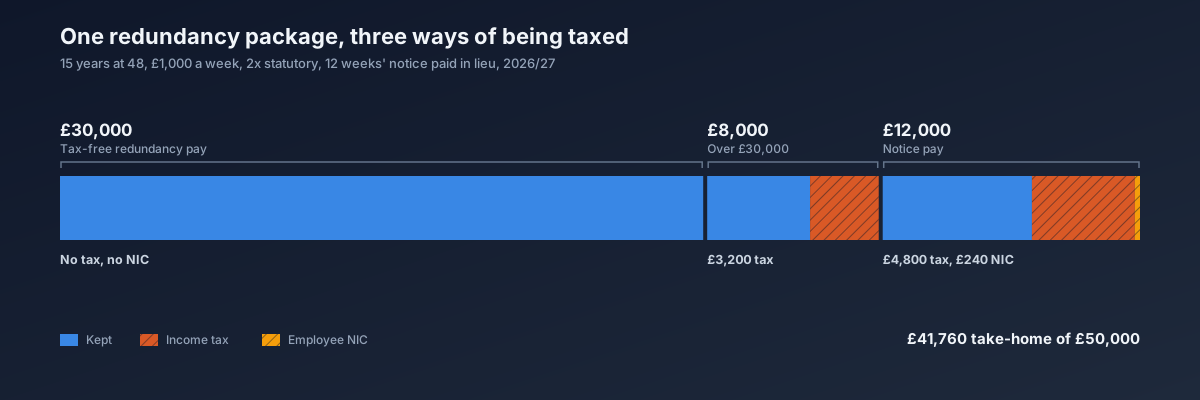
Now the good news, which there is some of. The first £30,000 of redundancy pay is tax-free. Statutory and enhanced redundancy pay share that one allowance, so it is £30,000 in total, not £30,000 each. For most people, that means all of it arrives untouched.
Anything over £30,000 is taxed as the top slice of your income for the year. Picture your year's income as a stack: salary at the bottom, then any notice and holiday pay, then the taxable redundancy pay on top. Tax is worked out on the whole stack, so the top slice pays whatever rate it reaches. If it crosses from the basic rate band into the higher rate band, part is taxed at 20% and part at 40%.
If it pushes your adjusted net income (broadly, your taxable income minus any pension contributions you make yourself) past £100,000, you also start losing your personal allowance, the £12,570 you normally earn tax-free each year. That one stings, and we come back to it under How to keep more of it.
You pay no National Insurance on redundancy pay, at any amount. Your employer pays 15% on the part over £30,000 (a charge called Class 1A National Insurance), but that is their bill, not yours, and it doesn't come out of your payment.
There is a third, rarer case. If your notice is neither worked nor paid under a PILON clause in your contract, HMRC still treats an amount equal to the pay you would have earned during that notice as taxable earnings. It has the catchy name of post-employment notice pay, and it doesn't count towards the £30,000 either. Our calculator does not model it, so every example below has its notice either worked or paid in lieu.
In Scotland, Scottish income tax bands apply to the taxable part. In example B below, that makes the tax on the amount over £30,000 £3,360 instead of £3,200. The tax-free £30,000 and the National Insurance rules are the same across the UK.
Three worked examples
Rules are easier to follow with people attached, so here are three. They are illustrations rather than real people, all in England, all leaving on 30 October 2026, and in each case the payout lands on top of a full year's salary.
Helen is the one with the most to gain from planning ahead, which brings us neatly to the next section.
How to keep more of it
There is one well-trodden way to cut the tax on the amount over £30,000: put some or all of it into a pension instead of taking it as cash. How that works depends on who pays it in.
Your employer pays it in. If your employer pays part of the payment straight into your pension, HMRC does not tax that part as a termination payment, and it does not use up any of your £30,000. Your employer pays no Class 1A National Insurance on it either. The contribution has to be arranged before the payment is made: once the money has been paid to you, it is yours, and it has been taxed.
Here is what that does for Helen, from example C, if her employer pays the whole £38,250 over the limit into her pension:
| Without a contribution | With £38,250 paid in | |
|---|---|---|
| Redundancy pay taxed | £38,250 | £0 |
| Income tax on it | £19,183.50 | £0 |
| Employer Class 1A National Insurance | £5,737.50 | £0 |
| Adjusted net income for the year | £150,250 | £112,000 |
That is £19,183.50 less income tax. The full £38,250 lands in her pension, where as cash only £19,066.50 of it would have reached her bank account. Her adjusted net income is still above £100,000 either way, because of the notice pay, so she still loses part of her personal allowance. If you have children, crossing £100,000 can also cost you childcare support, which our article on the £100,000 childcare cliff works through.
You pay it in yourself. If the money has already been paid to you, the door is not closed. You can pay it into a pension yourself, and because the amount over £30,000 counts as relevant UK earnings (the earnings HMRC lets you claim pension tax relief against), a personal contribution from it gets tax relief in the usual way.
Either way, contributions count towards your annual allowance, the most you can pay into pensions in a year with tax relief, which is £60,000 for most people in 2026/27. It is lower for very high earners, and unused allowance from the previous three years can be added to it; our figures do not model either. And the honest catch: money paid into a pension stays there until you are old enough to take it out, so it does nothing for this year's bills. If the payout is what keeps you afloat while you find your next role, that matters more than the tax. Our article on salary sacrifice explains the same mechanism for ordinary pay.
If you are offered a settlement agreement
Some redundancies come with a settlement agreement. This is a legal agreement in which you give up the right to bring claims against your employer, such as an employment tribunal claim, in exchange for a payment. It is only valid if you get advice on it from an independent adviser first, and Acas says the employer should consider offering to pay for that advice, though it does not have to. The redundancy part of a settlement payment follows the same £30,000 rule as above. Acas publishes guidance on settlement agreements.
If your final payslip is overtaxed
Don't panic if your last payslip looks brutal. A payment made after your P45 (the form your employer gives you when you leave) has been issued is often taxed on an emergency tax code, such as 0T. That code gives you no tax-free allowance for the payment, so it can take far more tax than you owe. The overpayment is yours to claim back: gov.uk explains how to claim a tax refund.
What these figures assume
- Tax year 2026/27, with England, Wales and Northern Ireland income tax bands, unless we say otherwise.
- The payout lands on top of a full year's salary. If you leave part-way through the tax year, your other income for the year is lower, so the tax shown here and in the calculator is higher than you will actually pay.
- National Insurance on notice and holiday pay is worked out at the rate for your annual salary. Payroll charges it per pay period, so a large lump sum paid in one month usually carries less National Insurance than shown.
- Not modelled: carry forward of unused pension allowance, the tapered annual allowance, student loan repayments, post-employment notice pay, and any effect on benefits.
One last thing
Redundancy is one of the hardest things most of us go through at work, and the money is only part of it. We hope this has taken some of the guesswork out of that part, so you can save your energy for what comes next.
And be kind to yourself in the meantime. Take the time off you are entitled to, lean on the people around you, and remember that this was a decision about a job, not about you. When you are ready to see your own numbers, the calculator is just below.
References
- Redundancy: your rights - GOV.UK (accessed October 2026)
- Redundancy: your rights, statutory redundancy pay - GOV.UK (accessed October 2026)
- Redundancy pay - nidirect (accessed October 2026)
- Termination payments: what you'll pay tax and National Insurance on - GOV.UK (accessed October 2026)
- EIM13505 - Termination payments and benefits: the £30,000 threshold - HMRC (accessed October 2026)
- EIM13874 - Relevant termination awards received on or after 6 April 2018 - HMRC (accessed October 2026)
- 2026: Class 1A National Insurance contributions on benefits in kind, termination payments and sporting testimonial payments - HMRC (accessed October 2026)
- EIM13735 - Termination payments: contributions to a pension scheme - HMRC (accessed October 2026)
- PTM044100 - Contributions: tax relief for members: conditions - HMRC (accessed October 2026)
- Tax on your private pension contributions: annual allowance - GOV.UK (accessed October 2026)
- Check how to claim a tax refund - GOV.UK (accessed October 2026)
- Jobseeker's Allowance: eligibility - GOV.UK (accessed October 2026)
- Redundancy - Acas (accessed October 2026)
- Settlement agreements: making a formal offer - Acas (accessed October 2026)